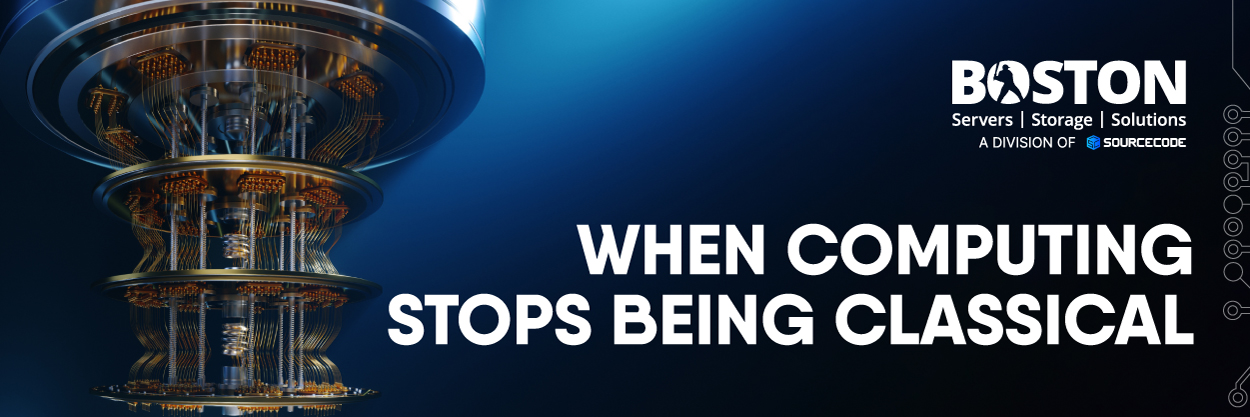
Quantum computing didn’t arrive with a bang. Instead, it spent years lingering at the edges of mainstream technology - talked about often, understood by few. It has been spoken about as everything from a silver bullet for artificial intelligence to a looming threat to modern encryption, yet for many readers it has remained abstract, fuzzy and comfortably distant. That is beginning to change.
In the past couple of years, quantum computing has started crossing a threshold researchers have talked about for decades. Elusive benchmarks are being reached, new systems are delivering the sort of verifiable performance that was once purely theoretical and strategic conversations once confined to physics departments and national labs are now taking place in boardrooms and CTO offices around the world.
To put this in context: in late 2025, Google’s Willow processor demonstrated the first practical quantum computing application verified to outperform a classical supercomputer by a factor of 13,000 on a specific algorithmic task, not a speculative claim but an empirical result that models complex physical phenomena faster than today’s best classical approaches could replicate. This is widely seen as a milestone in demonstrating what researchers term quantum advantage; the point at which quantum hardware can solve specific problems better than classical systems.
Yet this is not the story of a single moment. It is a story of ongoing evolution - one that requires a clearer understanding of what quantum computing actually is, how far the field has come and what it means for organisations today.
At its core, quantum computing represents a fundamentally different way of processing information. Classical computers, from your laptop to the world’s fastest supercomputers, represent data using bits that exist in one of two states: 0 or 1. Every calculation, no matter how complex, is ultimately a long sequence of these binary decisions. Quantum computers replace classical bits with qubits, which, thanks to the principles of superposition and entanglement inherited from quantum mechanics, can encode many possibilities simultaneously. This does not simply make them “faster”; it allows them, in certain specific contexts, to explore solution spaces that are effectively intractable for classical machines.
This is why physicists, computer scientists and forward-looking technologists talk not about incremental speed-ups, but about a new computing paradigm - one capable, in principle, of entire classes of calculation that today’s machines struggle with.
This shift is not hypothetical. Major research institutions are pouring resources into hardware breakthroughs. In 2025 alone, Quantinuum unveiled Helios, a record-breaking quantum computer with an architecture that dramatically reduces error rates and enables scalable logical qubits, hinting at a future where far larger and more reliable quantum systems are possible. Meanwhile, IBM’s ongoing roadmap, tracking increasingly capable processors and open collaborative verification of emerging quantum advantage experiments, suggests that verified quantum advantage could become more commonplace before the end of 2026.
These hardware advancements are important, but they are only part of the story. What matters for most enterprises is not raw qubits or futuristic lab rigs, it is where quantum meets real-world problems today.
Concrete experiments in markets such as finance are already underway. In fall 2025, HSBC reported that a quantum-augmented algorithm, developed with IBM, delivered up to a 34 % improvement in predicting bond trading outcomes compared with traditional models. This trial used quantum and classical resources in tandem to extract pricing signals that classical models miss. Such results do not mean quantum computers are everywhere tomorrow, but they signal a growing class of use cases where quantum-assisted techniques outperform older methods on industry-relevant tasks.
This convergence of progress is mirrored in how senior business leaders think about the technology. Recent industry research shows that while few organisations are deeply prepared for quantum, a growing number are already thinking strategically about how to position themselves. Investments in quantum R&D budgets have risen, capturing a meaningful share of innovation spend, and companies designated as quantum-ready exhibit not just technological ambition but organisational maturity in strategy and operations.
At the same time, quantum computing is stimulating another area of technological transformation: cryptography. The same physics that allows quantum machines to compute new solutions with immense parallelism also threatens to break the cryptographic systems that underpin today’s secure communications. In response, standards bodies like NIST have finalised the first set of post-quantum cryptography standards, and organisations worldwide are beginning to think about quantum-safe encryption not as theoretical future insurance but as strategic risk mitigation.
It’s a paradox worth noting: quantum computing is simultaneously an engine of future innovation and a catalyst for urgent cybersecurity planning. Organisations that understand both sides of this equation will be better positioned in the decades to come.
Importantly, becoming “quantum ready” does not require building your own quantum hardware. Much like cloud computing, access to quantum systems can be mediated through sophisticated hybrid models and cloud-based platforms. Developers and researchers can experiment with quantum circuits via established frameworks, while organisations can probe potential use cases using simulations and hybrid classical-quantum workflows.
This is precisely where Boston Limited’s collaboration with partners such as SECQAI enters the picture. SECQAI’s work in secure, hybrid quantum-classical architectures, including their pioneering Quantum Large Language Model (QLLM), signals how quantum-inspired approaches can be integrated with today’s high-performance systems. By enabling quantum experimentation within familiar infrastructure, they help bridge the gap between academic promise and enterprise experimentation.
Seen in this light, quantum computing does not emerge as a sudden revolution, but as a wave of capability offering layered opportunities: optimisation techniques that outperform classical heuristics, enhanced modelling across chemistry and materials science and AI systems that tap quantum-augmented insights. It also forces organisations to re-evaluate assumptions about risk, resilience and long-term infrastructure, especially in security and cryptographic agility.
It remains true that a universal, fault-tolerant quantum computer isn’t on every server rack yet. But the point is no longer whether quantum computing will matter - it’s already beginning to matter in discrete, measurable ways.
In the same way that enterprises once had to adapt to distributed computing, cloud platforms and artificial intelligence, they now face a similar imperative: to understand, experiment with and integrate quantum computing into their strategic roadmaps. Those who begin that journey thoughtfully today will be better prepared for tomorrow’s breakthroughs, and the value they promise to unlock.
Read other blogs in this Quantum Series:
Quantum Beyond the Hype: Why the next Computing Shift is already underway
This is not how Computers are Supposed to Work
Author
Max Martyn
Content Writer
Boston Limited